
Frequently Asked Questions
 Politics
 Economy
 Business
 World
World Defence
 Law & Justice
 Science & Technology
 Rida Prime
 About us
Have questions? We've got answers.
The Rida is a narrative-intelligence publication for readers who want to understand not only what happened, but also how an account of what happened takes shape. Every important news story reaches us twice. First as an event: a court judgment, an election, a war, a policy decision, a corporate failure, a scientific breakthrough. Then as a narrative: through headlines, quotations, omissions, historical analogies, political priors and editorial judgments about what deserves emphasis. Rida examines both. Our ‘Summary’ is a deep dive, which reconstructs the news story itself: the facts, chronology, institutions, evidence, competing claims and relevant history. Our Narrative Analysis then examines how leading publications have interpreted and framed that same material—where they agree, where they depart, and what those differences reveal. We are trying to make one demanding act considerably easier: to understand an important story in full before deciding what to think about it.
“Bias” is often used too casually. It is treated as a synonym for error, propaganda or political affiliation. That is rarely sufficient. Most consequential bias is subtler. It can reside in selection: which facts enter a story at all. In emphasis: which fact becomes the headline and which is relegated to paragraph fourteen. In language: whether an action is described as a reform, a rollback, a protest or a disruption. In sourcing: whose account is treated as authoritative. And in context: what history the reader is given before being asked to interpret the present. None of these choices necessarily makes a piece of journalism false. But together they can profoundly shape what the reader believes the story means. The Rida is interested in that space between factual accuracy and narrative effect.
Because facts and news do not interpret themselves. A news reader can be presented with an entirely accurate set of facts and still be led towards a partial understanding of the event. What is foregrounded, what is omitted, which causal explanation is privileged and which comparison is invoked all influence the conclusions we draw. This becomes especially important when a story is politically charged, emotionally salient or rapidly developing. In such moments, the first coherent narrative often becomes more durable than the later, more complicated truth. To understand the news well, therefore, it is useful to ask two separate questions: What do we know? And: What are we being encouraged to conclude from what we know? The Rida is built around the distinction.
Every Rida analysis has two layers. The Summary is a deep dive which begins beneath the headlines. It reconstructs the event using the best available evidence: primary material where possible, credible reporting, relevant data, institutional context and the history necessary to understand why the story matters. The Narrative Analysis then changes the angle of view. It examines how different publications have converted that underlying reality into competing accounts: what each considers important, what it minimises, whose voices it amplifies, what assumptions it makes and where its interpretation departs from others. The two layers matter because either one, alone, is incomplete. Context without narrative awareness can leave a reader vulnerable to framing. Narrative analysis without command of the underlying facts becomes little more than commentary about commentary. The Rida attempts to do both.
The Rida focuses on news stories dealing with systemic themes which materially shape public life, institutions, markets, and the way we understand the world. Our intended editorial mix is approximately: 30% — Politics, government and public policy Elections, legislation, regulation, state capacity, political institutions and the exercise of public power. 25% — Business, economy and markets Companies, capital, economic policy, regulation, competition and the decisions that shape how wealth is created and distributed. 20% — Geopolitics and world affairs War, diplomacy, trade, great-power competition and global developments with particular consequence for India. 15% — Law, society and institutions Courts, rights, social change, education, public institutions and conflicts over the rules by which societies organise themselves. 10% — Technology, science and the future Artificial intelligence, digital platforms, climate, scientific change and technologies capable of altering the structure of everyday life. These percentages are editorial bearings, not quotas. News does not arrive in neat proportions, and we have no intention of forcing it into them. The Rida is written from India, but not confined by India. A war in Europe, an election in the United States or an AI breakthrough in California may matter enormously to an Indian reader if it changes the world that reader inhabits.
We are not trying to cover everything. That is partly a practical choice and partly an editorial conviction. The modern information environment already suffers from an excess of supply. The problem is less often that readers cannot find information than that they cannot determine which information deserves sustained attention. We therefore look for stories that are consequential, contested, misunderstood or likely to remain important after the news cycle has moved on. A strong The Rida story usually contains one or more of the following: genuine disagreement over what the facts mean; sharply divergent media narratives; missing historical or institutional context; important primary material that has not travelled with the headline; or public certainty that runs ahead of the evidence. Our ambition is not to help readers know something about everything. It is to help them understand the things that matter unusually well.
Each solves a different problem. A news aggregator helps you find the news. A newsletter helps you keep up with the news. A fact-checker helps establish whether a particular proposition is true or false. The Rida asks a broader question: After examining the evidence, the context and the competing accounts, what is the most intelligent way to understand this news story? That requires more than collecting links or adjudicating isolated factual claims. It requires reconstructing the underlying event, understanding the relevant institutions and history, comparing how different publications have represented it, and identifying where disagreement reflects evidence, ideology, emphasis, uncertainty or simply a different choice of frame. Rida therefore aims to provide something rarer than information: orientation.
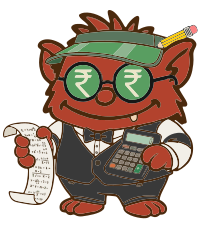
The Ruru is The Rida’s mascot—and, in a sense, its editorial shorthand. Different versions of our Ruru appear alongside our analysis to capture the prevailing character of a particular piece of coverage. A report that is strikingly sympathetic to the government may, for instance, receive a “Pro-Government Ruru”, accompanied by a suitably recognisable Ruru avatar. Other forms of coverage may receive different monikers and visual treatments. These are what we call Ruru Ratings. They are not numerical scores, nor are they intended to replace analysis with a label. Their purpose is to give readers an immediate, memorable sense of the editorial posture of a piece before they engage with the detail. Every Ruru Rating is accompanied by notes explaining the language, framing, sourcing, emphasis or omissions that led us to that characterisation. Convergence & Divergence then shows where different publications are substantially telling the same story—and where their accounts begin to separate. The Quote Spectrum examines who is being allowed to speak within the coverage: which institutions, experts, political actors or affected voices are shaping the reader’s understanding, and which perspectives are conspicuously absent. Our Ruru gives you the instinctive read; the rest shows you the evidence behind it.
Not by assigning permanent ideological labels to entire publications. We think that approach often creates the illusion of understanding while concealing the harder work. A publication may be rigorous on one subject and incurious on another. It may report the central facts accurately yet consistently privilege one set of sources. It may provide excellent original reporting while framing the implications through a recognisable institutional or ideological lens. The relevant unit of analysis is therefore often the story, not the masthead. We examine the coverage in front of us: its evidence, framing, language, omissions and sourcing. Nor do we confuse fairness with compulsory symmetry. Sometimes one argument is better supported than another. Sometimes the evidence is genuinely unsettled. Sometimes a claim repeated by many publications remains weak. Our obligation is not to manufacture balance. It is to describe the balance of the evidence as faithfully as we can.
This may be the most important question we can be asked. The Rida is not written from nowhere. We choose which stories matter. We decide which sources deserve weight. We make judgments about relevance, evidence and interpretation. Those decisions inevitably reflect assumptions, experience and human perspective. The answer, in our view, is not to claim an impossible purity. It is to build habits that make error and bias more visible, more contestable and easier to correct. We distinguish fact from inference. We prefer primary material where available. We expose meaningful disagreement rather than smoothing it away. We make uncertainty explicit. We explain why we reach a conclusion. And we remain willing to revise that conclusion when the evidence changes. The post-truth problem is not simply that people believe false things. It is that confidence has become cheap, context has become scarce and information is increasingly filtered through narratives designed to confirm identities before they illuminate reality. The Rida cannot stand outside that environment. But it can try to participate in it with more discipline. We do not ask readers to exchange somebody else's certainty for ours. We ask them to see more clearly how certainty is made.
The Rida is for readers who still believe that being informed should require more than being updated. It is for professionals, founders, investors, lawyers, policymakers, academics, students and curious readers who need to understand consequential events without spending hours reconstructing them from competing accounts. The value of Rida is not that it gives you more to read. The internet has solved that problem rather decisively. The value is that it does much of the difficult work that serious reading now requires: finding the relevant material, establishing context, comparing competing narratives, identifying what is missing and separating what is known from what is merely asserted. For ₹3,999 a year, Rida offers a different relationship with the news. Read less of it. Understand more of it.